Showing posts with label Raising Emotionally Healthy Kids. Show all posts

Saturday, April 4, 2015

How to Teach Kids About Processing and Handling Their Emotions

First we had a Time Out chair.
Then we nixed the idea of punishments altogether and began leaning towards effective gentle discipline- which led to the Calm Couch.

And now we have this: The Safe Place.


We call it the Safe Place because it's the one place in our house where our kids can go if they are dealing with difficult emotions and safely process them with the help of the visual and tangible aids I placed there.

When a tantrum ensues I ask my child if she/he would like to go to the safe place so we can handle it. Sometimes they go there on their own. Sometimes the emotions get the best of them and they refuse to go to the Safe Place at first.

Both are fine. I never force my kids to go there as that would defeat the purpose of it being a Safe Place. It is not a place of punishment but a place of rest and comfort.

Because dealing with emotions is hard. ESPECIALLY if you are little and you only understand 3 basic emotions: Happiness, Sadness, and Fear.

The goal of our Safe Place is to encourage our children to understand the more complex underlying emotions that hide behind our basic emotions and teach them how to cope with them in a safe and productive manner.

So we placed a few key items near the extremely large and comfy Papasan Chair (where we both fit if necessary) that gently encourage and teach these principals.

1. A basket of books that focus on Emotions. A few of the titles we chose are:


2. A large mirror: This is especially helpful for younger children so they can see their emotions in action. My 3 year old always goes to the mirror first before she heads to the chair. Sometimes she will sit there for several minutes and watch herself cry. Visually seeing themselves express their emotions helps develop empathy and encourages a deeper understanding of themselves and their emotions.

3. Pictures of our family in photo albums- I placed a few photo albums inside the book basket to remind them of how much we love and care for each other. This is usually what my children choose to look at while in the safe place.

4. A stuffed animal or two. One of the ways my children can choose to cope is by hugging a Teddy so we have one right on hand.

5. A canvas painting that labels our Safe Place and expresses our goals for the Safe Place: "I'm Safe Here." I made this myself- although I am a self proclaimed hobby artist I'm pretty sure anyone could whip this craft up regardless of artistic skill.

and then most importantly:
6. Our Emotion Charts.


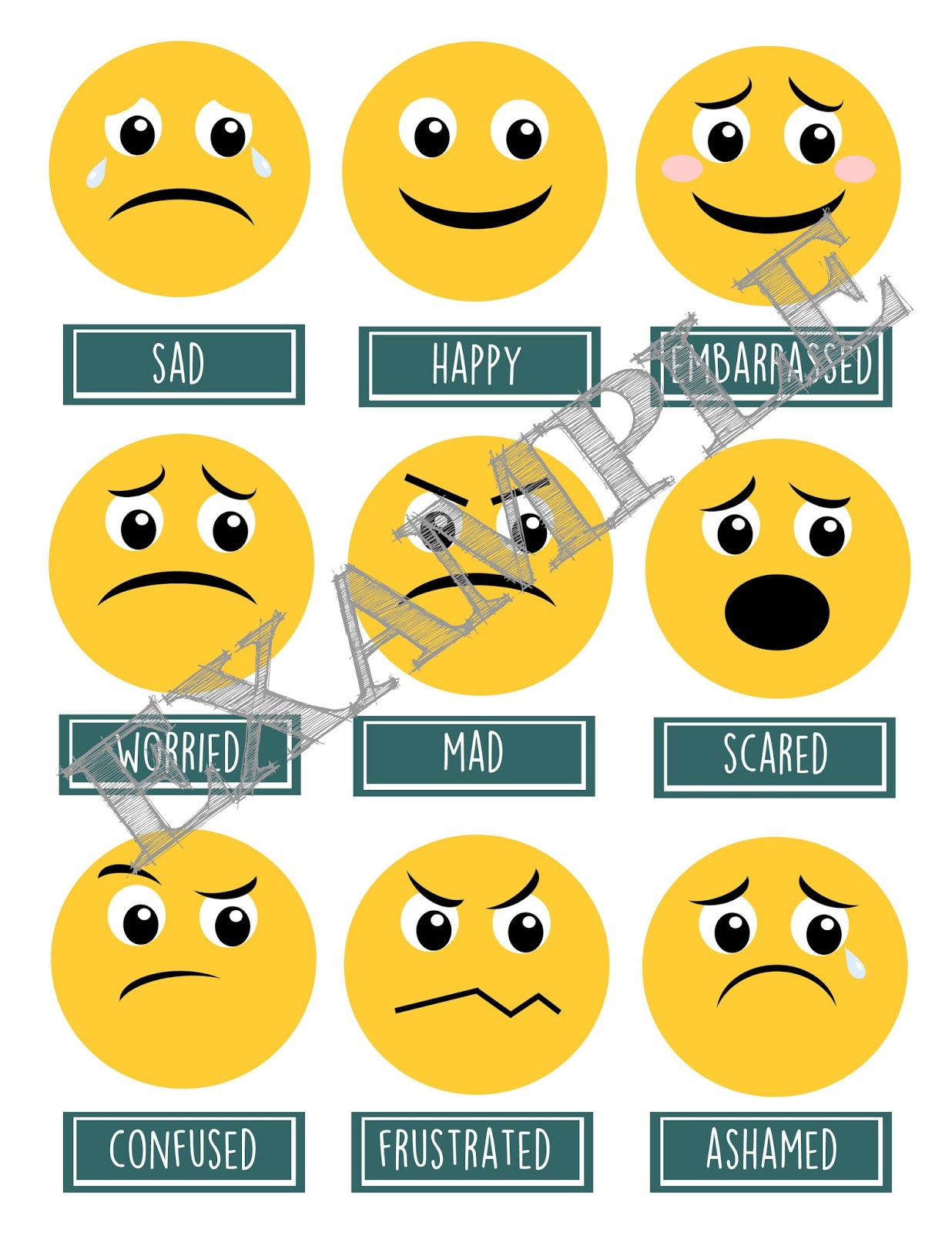
I designed these pages so my children could learn to identify their emotions and then learn how to safely cope with the emotion in a tangible, visual, and interactive way.

The pages are designed to fit neatly into 8x10 picture frames so they stay protected from dirty little fingers, and then include extra pages so you can laminate and cut out the emotion faces and coping techniques so they rest on top of the glass of the picture frames via velcro dots. This allows the child to choose an emotion, move it to the "I Am Feeling" chart, and then choose a way to cope and move it over to the "I Choose to Handle it By" chart.

Like this:


I'm extremely excited to offer this kit in my Etsy Store for just $5 as an instant download! 

The kit includes the 4 charts shown above and below,  as well as an extra page of emotion faces to be laminated and cut out for interactive use, and an extra page of the Coping Choices to be laminated and cut out for interactive use.
And of course instructions.



Our Safe Place is such a huge hit in our family even my 10 year old will occasionally rest there. And I love that:) 
Occasionally my 3 year old will play with the faces and swap them out. I'm OK with that too because it is through Play that children learn best. Also, I figure that although they are a great tool to have on hand when a tantrum erupts, she is likely to learn more from them when she is calm and happily pretending with them. 

If you would like to purchase this download CLICK HERE

and of course as always- 
HAPPY PARENTING!

Friday, August 30, 2013

Building Trust and Acceptance through Play


Children- especially babies and toddlers, learn a great deal about themselves, others, and how the world works through play.
They are discovering their likes and dislikes, their hobbies, and learning how to share and cooperate, among a myriad of other things cognitively and developmentally.

Yet how often do we as parents tend to "guide" their play?
How often do we unknowingly "restrict" them by pointing at or giving them toys they aren't focused on?
Or "help" them by pushing the button for them, building the blocks for them, or teaching them how the toy works?

"Relinquishing any parental agenda sends our baby a powerful message of trust and acceptance, “Whatever you choose to do when you play is interesting to me. It’s ‘enough’,” rather than, “Don’t do what you feel like doing, do this.” .....

(or worse yet, "you can't do it, let me do it for you.")

"When we nurture our baby’s individuality by allowing her to stay in touch with her true self, she can grow up feeling comfortable and proud of the person that she is, more able to trust her instincts, accept her feelings and those of others. Surely, this is one fundamental key to happiness?"  - Janet Lansbury

Wednesday, August 21, 2013

It's All About Respect.


What if others constantly grabbed you, touched you, or removed you from your current activity/position with out asking?

Children have personal boundaries too. They deserve respect. And one of the best ways to teach respectful personal boundaries (both to themselves and to others) is by emulating it.

If they say "No", respect that. Children need to learn that it's OK to say "no". 

Ask if you can hold their hand instead.
Encourage the independent child to follow you instead.
Explain where you are going and why if necessary. Especially if you have to carry them due to circumstances beyond their control.


Look at it from their perspective. If you wouldn't want it done to you- don't do it to them. It's that simple. Because children are Human Beings, not loose change.


Friday, April 5, 2013

Yoga For Kids

I found THE coolest FREE  yoga videos for kids! Even my 18 month old got in on the action!


Your lovely guide through your Yoga adventures is Jaime- the cutest British thing in media since Pocoyo!


Each video is about 15 minutes long and your kids will go on adventures like:

Packing a picnic and visiting Squish the Fish

and Pretending to be a cat!


Over on her blog she has yoga ideas, lesson plans, teacher training, and even ideas on how to tie nursery rhymes into yoga poses! {She also has a DVD you can buy}

You can find all her YouTube videos in one place HERE.

We have been using these videos to wake our bodies up in the morning and my kids love them so much we'll even turn them on for a second or third time a day to get wiggles out or to calm down right before bed.


Thursday, March 28, 2013

Free Montessori Emotions Cards


Want to know what I think is hands-down, bar-none, one of THE most important things you could ever teach your kids? Understanding, labeling, and coping with their emotions.

(scroll down for the FREE Download!)

Did you know that ANGER is a COVER-UP emotion? Some call it a "fake" emotion because it is used as a coping mechanism to cover-up and suppress the true emotion that is being felt.

Don't believe me? Let me give you some examples:

Jealousy- Jealous of your neighbors, jealous of something someone else has that you don't, jealous when someone you love gives too much attention for your liking to something or someone else.... what do you normally do? Get mad at that person/thing? I thought so :)

Frustration- When you are frustrated that your kids are destroying your house, that someone isn't listening to you.... what is your normal response? Anger?

(those are probably the 2 most common feelings that are covered up by anger- but I know adults who get mad when they are actually sad and could use a good cry, and I've even seen someone get mad when they were unsuspectingly surprised!)

Children are especially prone to expressing anger instead of their true emotions. Intense excitement for something can result in anger due to lack of patience or a misunderstanding of suspense. Embarrassment is often covered up by anger, and obviously frustration and jealousy.
It's not that most children WANT to feel mad... they just haven't quite figured out the more complex feelings they are experiencing besides Happy, Sad, and Mad.

So how can you help them?

Well now that you know that anger is a cover-up emotion, next time your child is upset about something instead of sending them straight to time-out, (click here for time-out alternatives)
TALK WITH THEM and get to the bottom of their true feelings.
Identify and label the feeling with them.
and Teach them proper coping mechanisms

FYI- There are a TON of healthy ways to cope!
It's perfectly OK to cry!
It's perfectly OK to feel the need to scream (but please scream in your room into a pillow because that's the respectful thing to do for those around you)
and it's perfectly OK to get upset. I'm not telling you that they (or you) should never be upset.

Anger is just usually the first emotion to show up! The trick is to break through it so you can process your feelings and find the appropriate coping mechanism!

Because people (and children) who get angry and don't know how to cope usually break things or harm others. Unprocessed anger is bad for the soul. It leads to hate, resentment, and sometimes violence.

Sometimes you don't need a coping mechanism at all! Once you realize that you weren't really mad, you were actually just really disappointed, or frustrated, or overwhelmed- you can just solve the problem causing the emotional distress to begin with!
For example, if your child is overwhelmed, teach him to take it one step at a time, help him with whatever it is that's overwhelming him, (in our house it's usually about picking up toys) Label the feeling for him so he can become aware of the difference between feeling angry and feeling overwhelmed.

This is a fantastic parenting tool by-the-way. Imagine the breakthroughs you can have with your children! Especially anger-prone children.

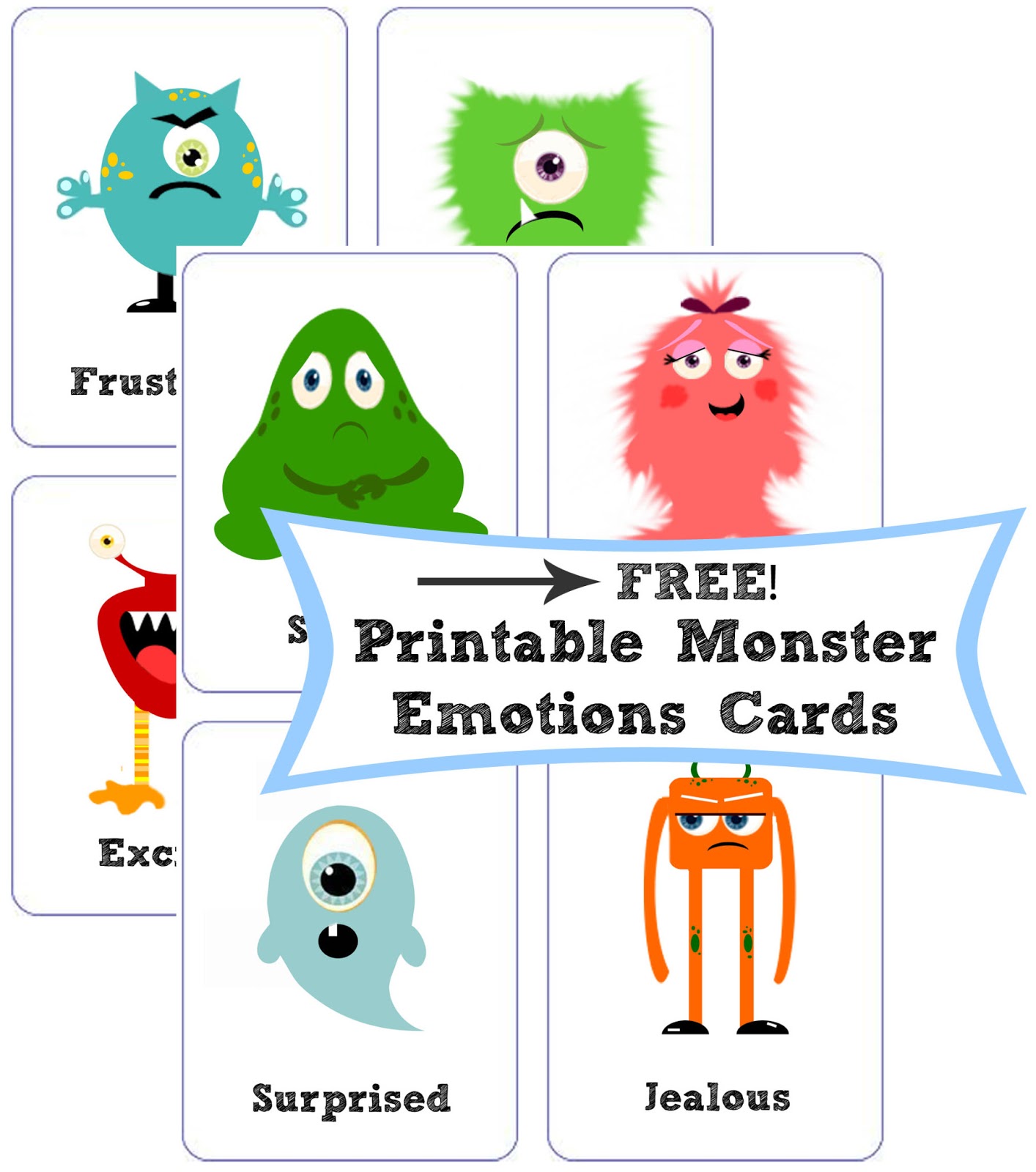
I created these Monster Emotion Cards as a Montessori-type aid in teaching my son more complex emotions. When I gave them too him we had a fun child-led discussion about each one. He had so many questions!
"What is this one feeling?"
me: "He's feeling frustrated"
"Why is he feeling frustrated?"
me: I don't know... when do you feel frustrated?"
"uuummm... I don't know."
me: "How about when Mommy is on the computer and doesn't listen to you?" (GUILTY!)
"Yes. That makes me feel VEEEERRY frustrated!"

I now have them taped on our fridge for easy referencing. 

These would be fun to frame and decorate with as well


Tuesday, March 19, 2013

I Don't Force My Kids to Share... & Why That's a GOOD Thing!


I recently stumbled across this article and loved it so much I just had to share it with you guys. 

------------->  Why I Don't Make My Son Share <---------------

You see, I do this too! Always have, and always will..... with every one of my kiddos. 


I'd go into detail about the million reasons why but she does such a good job at explaining it that I'm going to simply persuade you to hop on over to her lovely blog and read it for yourself.

But before you go let me back her up by saying this: IT WORKS! (I've got 4 kids of all age ranges to prove it) 
 It teaches patience, tolerance, how to cope when someone tells them "no", and respect for themselves & their belongings. While sharing is important- setting up personal boundaries is important too IMO. There is a time to share, and it doesn't hurt to ask your child if they WANT to share- but there is no reason you should force your child to share simply because another child wants something they have.

Oh- and before I let you go let me tell you how I teach this concept in my home:

We ASK if they WANT to share first. They are perfectly entitled to answer YES or NO. 
If said child's answer is no I teach the other child how to cope by saying something like the following:

"That's her toy and we have to respect that she has the right to decide who gets to play with it and when. You get to decide with your toys too. Let's find something else to play with or wait until she's ready to share."

or

"He was playing with that toy first and it would be rude to insist that he give it up simply because you want it. We have to respect other people's boundaries and belongings. Let's find another toy or wait until he's done playing with it." 
 ________________________

Ok- now hop on over to her blog and read that article! It'll be worth your time. I promise!


Tuesday, November 13, 2012

Teaching Children about Positively Coping with their Emotions

{This article is strictly my non-professional, non-degree holding opinion. Seek professional help in diagnosing your child for overly-emotional behavior if necessary. I am simply a mother of 4 who almost has her degree in Early Childhood Development, and who reads A LOT of books and articles on childhood development and parenting. This article is a culmination of many things I've learned through classes, textbooks, articles, and through personal implementation in my home.}

*Warning- this is a long post as it is a topic that is very dear to my heart! But there are free printables at the bottom and a TON of very informative and liberating information in this post that I KNOW could benefit your family and even you personally as an adult, so I urge you to take the time to read it:)
 ------------------------------------------------------------------------------------------------------------------------

This is a topic that I find is often overlooked in childhood development. Unless you have a child who is Autistic or have a "Montessori" approach to raising your kids, this probably isn't something that you have thought about before... in depth.
Come to think of it, I think it's fair to say that this is a topic that many adults could also benefit from!

Teaching children to regulate their emotions in a positive way is probably
 one of the most important things you could ever give them for their future selves and their future relationships. It is important to note that you MUST let your child experience sadness, anger, frustration, and other emotions that are typically labeled "negative". There is nothing negative about feeling these emotions. They are raw, human emotions that must not be suppressed! They only become negative when you don't have a healthy way to express them.
All parents want their children to be happy. And many parents struggle watching their children get sad, frustrated, or upset. Maybe they lose patience in struggling with an over emotional child and send them to "time-out" or send them to be alone in their rooms. Maybe they downplay the child's emotions and try to overshadow them with "my problems are bigger than yours"... or "there are children starving in Africa!" or "you don't see jimmy crying over this!" or maybe they give in and give the child whatever it is they want. In all these scenarios the child will eventually calm down... but the root of the problem was not solved and therefore the behavior WILL exhibit itself again.  And worse, in many of these situations what the child actually learns, is to suppress their feelings.

Let's talk about what happens when children are taught that it is best to be happy all the time and that crying and getting upset only gets them in trouble.... or in other words... taught to suppress "negative" emotions.
When children have to hold in and suppress natural, raw, human responses to outside stressors major internal confliction can result and in some cases can even lead to physical ailments such as being prone to anxiety, depression, or even Conversion Disorder. This is especially true in children between the ages of 10-18.
Even children who come from really great, well-meaning families with a lot of love and support can learn to suppress their feelings simply because they themselves don't personally like experiencing "negative" emotions and never learned how to cope or get through them. This will typically lead to a child who is quiet or reserved, an overly sensitive child who cries or gets upset easily, or a child who is secretive and whose usual response is, "I'm fine." even though you as a parent know they are not.
Young children will throw a lot of tantrums, or may exhibit seemingly overly sensitive behavior by crying over everything.


Sow how exactly do you teach positive emotional coping skills? It's actually easier than you may think! And it's never too late to start.

Young children typically know 3 basic emotions: Sadness, happiness, and anger. So all other emotions they experience often get miscategorized into one of those 3 basic feelings. For example, When Jimmy wants Daddy's attention and Daddy is otherwise detained, Jimmy eventually acts out with anger. But his true and correct emotion is probably that he was lonely, feeling neglected, or frustrated that Daddy wasn't listening... or maybe a combination of those feelings. Or when Jill cries because her Mother is doing her hair in the morning, she is more than likely not sad, she is probably frustrated from perhaps the lack of independence, or maybe anxious about the end result and how it will end up looking. Even happiness can be misinterpreted as odd as that sounds. Feelings like: proud, loved, excited, or confident could all also be described as feeling happy to a child.

Teaching young children the many other emotions they could be feeling is liberating for them!

Imagine learning that anger is a cover-up emotion. That it ALWAYS is covering up a "true" emotion. In fact, it is often called a "secondary emotion" because it is a defense mechanism and used to cover up your true feelings. (I know adults that could benefit from learning that) So now next time little Jimmy is angry you get to skip that whole "mad" step that often lasts a very long time and go straight to the root of the problem. He's upset- but now you know that anger is a cover-up emotion, so what is he really feeling?
*Communicate with him!
*Ask him if you don't know what's bothering him!
*Teach him that anger is a cover up emotion and eventually he will learn to calm down and regulate on his own... even if that isn't until he's an adult.
Imagine what a safe and healthy place his mind will be as a teen and an adult when, even though he is choosing to be angry and exhibit those feelings (because sometimes hormones are hard to control and hormones play a huge role in how we control and show our emotions) he knows that deep down inside he not angry- because you taught him that anger is a cover up emotion, so he eventually assesses the situation and realizes that in fact he is actually disappointed, confused, jealous, or maybe ashamed. When you get to the root of the problem, you SOLVE the problem. Now that he knows he is actually, let's say, jealous... he can take steps to control or rid himself of the jealousy, instead of trying to cope with the anger.
 Imagine learning as a little child what it means to be embarrassed, and that it's OK to be embarrassed! All this time you thought that you were just another form of mad or sad, when in fact you were actually feeling embarrassment!  Or imagine that you learned what it meant to feel overwhelmed. That is a very real feeling for young children that almost always exhibits itself as anger. Telling, and even helping Jill to clean up her messy room might often lead to her showing feelings of anger and frustration. But now you know that anger is a cover up emotion, so maybe she is actually feeling overwhelmed! 20 toys seems like a quick and easy 2 minute clean up to the very-experienced-you, but to little Jill those 20 toys might look more like 200 toys! And when you don't know how to micromanage, in her little mind she might as well be cleaning a house straight out of TLC's "Hoarders". She is experiencing what it feels like to be overwhelmed but doesn't know what that is, let alone how to cope with it other than to cry and get angry.

So how exactly do you teach children the many emotions there are and how to positively cope with them? Communication and being an example is KEY. But let me get more specific:

ALL children could benefit from something as simple as a feelings chart or feelings cards on the wall. When your child cries or gets angry, walk over to the chart and ask them to identify how they are feeling.

These free printable cards by Mr. Printables are cute and simple enough for little ones. You can cut them out and use them as cards, or you could simply print it out and post it on your fridge or your wall.

This Emotions Flyer is better for children who are a little bit older as there are a lot more emotions to choose from. 

You could also create your own by taking pictures of your child's face expressing each emotion. Ask them to show you what "shocked" looks like and then take a picture of their "shocked face"

Whichever you choose, when your child cries or gets upset, lead them to your feelings or emotions poster/cards and start asking questions:
How are you feeling? (if they point to sad or angry ask them how else they are feeling)
What made you feel that way?
What can I do to help?
What can you do to help?
Always end with, "It's OK to feel those feelings. I feel that way sometimes too." And then if they acted out in a negative way discuss how they could positively express those feelings in the future.

Of course the younger children will need to learn what those feelings actually are so a great way to teach that are through children's books, or even by getting their attention when you are feeling that way or when you see others experience them, even if it's in cartoons. Here are a few books I highly recommend. There actually aren't very many "feelings & emotions" books on the market sadly enough which gives you an idea of how overlooked of a topic this is in parenting!


My own children have HUGELY benefited from learning to identify their many complex emotions and how to positively cope with all of them. We use a lot of "how does that make you feel?" statements in my home as I want them to internalize and really evaluate their feelings and what effects them positively and negatively. 
When my 3 year old son draws me a picture, instead of robotically stating, "Good Job! I love it!" I instead say, "Good job! How does drawing that picture make you feel?"
When my 8 year old comes home with a 100% on a math test my statements are usually, "Wow! How does that feel? So studying really hard must have really paid off for you!"
----
I have a Niece who is incredibly sensitive. She cried over almost everything. I had never thought to relay this parenting advice to my sister until she cried out for help on Facebook. I taught her about this concept and after just 1 week she said nothing has helped more than simply putting up an emotions poster and directing her to it when she cried. She stated she got results immediately and her little one just keeps getting better and better. Now when she cries, they solve the problem instantly and her little 4 year old feels acknowledged, loved, and is learning how to problem solve, identify, and cope with her emotions in a more positive way.

Because of the lack of free printable emotions cards available online, I myself am in the process of creating some. When they are finished in a few days, I will post them on here!

Happy Parenting or better yet, "Emotion Coaching!"

Saturday, October 29, 2011

Article: Taming Tantrums

“Teaching kids to control their emotions is huge," ...... "We can't take away their feelings, but we can control how they communicate them to us. This is something that has to be taught though."
The question then becomes... how do we teach them that?
How do you get through to a 3 year old right in the middle of a tantrum?

I found this really great article that teaches us just that! 
and you'd be surprised at how simple the concept really is. 

Here's a couple of my favorite quotes from the article:


"While it might be hard to remember in the heat of the moment, the ultimate goal of the parent shouldn’t be to punish, but rather to teach. When a child is in tears over a parents' refusal to drive thru McDonald's, or screaming and flailing around when the TV is turned off, it’s actually a golden opportunity to show them how to regulate their own emotions."

“Calmly lift and move the child from one location to another (e.g., floor to a couch). {Click HERE for my post about setting up a CALM COUCH in your home. It would be the perfect place for your child to go in this scenario}This shows you are in control of the situation," he said. "You might pat them on the back and gently tell them they seem frustrated at the moment but when they are calmed down you'd love to talk with them. This labels their feelings, shows empathy, but requires a change in their behavior before you will give them your full attention. Your calm and compassionate approach will also serve as a reference for children who will then be better able to calm themselves.”

I posted another great article a while ago called:
Click on the link above to learn how to teach your children to identify and cope with their emotions